


Resale boom reshapes fashion spending as shoppers embrace 'Vinted Math' and rethink value of clothing
As resale continues to gain momentum, shoppers are changing the way they buy clothing, according to new research from Vinted.


The resale platform's 2025 Impact report revealed that nine in ten of surveyed UK buyers check Vinted before buying new items, with 35% saying that they think about the resale value of an item before purchasing something new.
Vinted has coined the term "Vinted Math" to describe this shift towards more value-conscious consumer behaviour, with CEO Adam Jay commenting that the findings show that "people are changing not just where they shop, but how they value what they own".


According to the findings, shoppers are becoming more strategic in their purchasing decisions, considering not only the upfront cost of an item - with customers spending on average 72% less by buying on Vinted vs the original retail price - but also its future resale value.
Research also found that 54% of Vinted sellers say they now take better care of belongings because they know they can resell them later, which reinforces the idea that consumers are increasingly starting to consider the long-term value of items.


Jay commented on the report findings: "For me, the interesting shift is that people are starting to think about value before, during and after a purchase - what they can save today, and what an item could be worth to someone else tomorrow.
"Our mission is to make second-hand the first choice. That’s why we want even more people to do the ‘Vinted Math’: before buying new. When millions of people make that small shift, resale becomes more than something people do after a clear-out - it starts to reshape how shopping works."



Vinted follows Vestiaire Collective in promoting fashion's resale potential
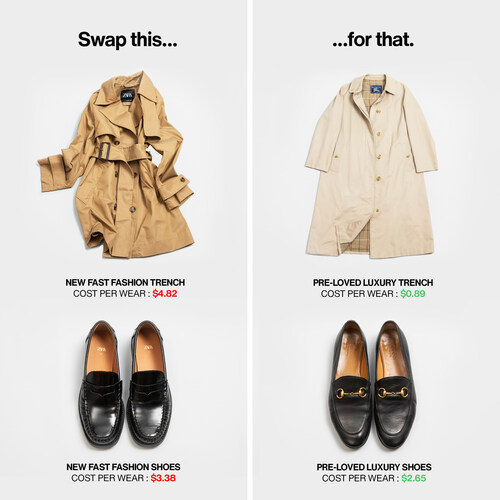
Vinted is not the only resale platform that has tapped into this shift in consumer attitudes. In its 2024 Circularity report, Vestiaire Collective introduced the concept of the "cost-per-wear" (CPW) metric, with the aim of educating consumers on the long-term value of clothing.
By breaking down the overall cost of an item by looking at frequency of wear, overall lifespan, and resale value, the campaign aimed to highlight the impact of overconsumption and fast fashion, while making the case for pre-loved luxury items. The metric was developed following a consumer survey that found that fast-fashion items were worn less on average, kept for less time, and had a lower resale value.
Pre-loved luxury pieces, on the other hand, were found to be worn more often, showing that they had better long-term financial benefits and lasted longer too.
"In today's climate of inflation, it is obvious: neither people nor the planet can afford fast fashion," said Fanny Moizant, co-founder and President of Vestiaire Collective, in a statement in 2024, although the statement still rings true in today's economic climate.
"We want to educate consumers about the benefits of circularity while sounding the alarm on fast fashion's devastating impact. This report is a wake-up call to combat overconsumption and overspending, fuelled by tempting low initial prices," she added.
Resale is booming
Vinted has greatly benefited from the surging demand for pre-worn items, with the company reporting a 38% jump in annual revenues to €1.1 billion (£957 million) for 2025, with a "strong" performance in women's and children's clothing.
It also reported an influx of new members joining the platform, which translated into a 47% increase in gross merchandise value traded on the platform to €10.8 billion (£9.4 billion).
More generally, this reflects a larger boom the resale market is currently experiencing, with strategic consultancy OC&C reporting that in the UK alone the market is £8 billion, having grown at circa 20% CAGR since 2019.
Almost one in four fashion transactions in the UK now flows through second-hand channels, according to the report, and the numbers are only set to grow.
By 2029, second-hand is forecast to account for around 10% of UK online fashion spend, with online resale in some geographies set to more than double by 2030.
As one would expect, competition in the sector is also getting more fierce.
While Vinted has been reporting growth in sales, eBay acquired second-hand clothing rival Depop in a $1.2 billion (£890 million) deal, set to close before the end of the year.
The current economic system is stacked against resale
Yet while the category is booming, and consumer enthusiasm is mounting, research by the Ellen MacArthur Foundation suggests that the current economic system is stacked against circular business models, including resale.
In a recently published report called The New Bottom Line, the Foundation outlined how current infrastructure and government policies often make producing new items from virgin materials more profitable than keeping existing ones in use, as manufacturing processes are optimised for high-volume production.
Circular business models, on the other hand, involve labour-intensive processes - including sorting, cleaning, listing and repair - that bring lower margins, high taxes, and costs that hardly decrease at scale.
To fix the "broken economics of resale and repair", the Foundation, as well as 68 fashion businesses including both Vinted and Vestiaire Collective, called for three concrete policy changes - including reduced VAT in the EU on resold products, as well as Extended Producer Responsibility (EPR) - to fund the infrastructure needed to collect and sort clothing at scale.
These targeted changes could raise gross profit margins to up to 55% for resale, according to the Foundation. Overall, the circular fashion market is already projected to reach $393 billion (£291 billion) by 2030, growing at twice the pace of the wider industry.

Marianne Gybels, Senior Director of Sustainability at Vinted, had commented on the policy changes: "To make circular businesses like second-hand the first choice, they have to consistently deliver on what matters most to consumers - being reliable, affordable and easy to use. We’re already seeing this shift across Europe, where buying and selling second-hand has become part of everyday life, with significant room to grow further.
"To unlock its full potential, policy should support business models that make circular choices more accessible. This helps second-hand scale further and provides consumers with high-quality, affordable alternatives that are significantly better for climate impact than buying new."
In conclusion, the rise of resale is far from over, driven by mounting consumer demand, especially for fashion. With cost-of-living pressures and inflation worries continuing to be top of mind for consumers, "Vinted Math" offers a key insight into how consumer attitudes are starting to shift.
With consumers likely to continue to monitor household spending carefully, the growth of resale will likely continue.


